 admin
admin red team assessment
Cybersecurity threats have become more advanced than ever, making it essential for organizations to evaluate their defenses using realistic security assessments. While many businesses are familiar with penetration testing, they often misunderstand how it differs from a red team assessment. Although both methods aim to improve security, they have distinct objectives, methodologies, and outcomes. Understanding these differences helps organizations choose the right approach based on their security maturity, business goals, and risk profile. Instead of simply identifying vulnerabilities, modern security strategies require testing that measures how effectively an organization can withstand sophisticated attacks carried out by skilled adversaries.
A red team assessment is a comprehensive security exercise that simulates the behavior of real-world attackers attempting to compromise an organization’s systems, networks, employees, and physical security. The primary objective is to evaluate the effectiveness of the organization’s overall security posture by testing its ability to detect, respond to, and contain an attack. In contrast, penetration testing focuses on identifying and exploiting technical vulnerabilities within a predefined scope. While penetration testers generally work toward discovering weaknesses in applications, servers, or networks, a simulated adversarial exercise measures whether those weaknesses can be combined to achieve meaningful business objectives without being detected.
One of the biggest distinctions between penetration testing and a red team assessment is the overall purpose of each engagement. Penetration testing is designed to uncover security flaws before attackers can exploit them. It provides organizations with a detailed inventory of vulnerabilities, configuration errors, insecure software, and potential attack paths that require remediation. On the other hand, the broader assessment evaluates whether an attacker can successfully bypass security controls, avoid detection, escalate privileges, move laterally across systems, and accomplish specific objectives such as accessing sensitive data or disrupting operations. The emphasis is placed on measuring defensive capabilities rather than simply identifying technical issues.
The scope of testing also differs significantly between the two approaches. A penetration test usually targets a specific application, network segment, cloud environment, or system based on predefined requirements. The engagement often has well-defined technical boundaries, allowing testers to concentrate on finding vulnerabilities within those assets. A red team assessment, however, typically involves a much wider scope that may include external infrastructure, internal networks, wireless environments, cloud platforms, employee behavior, physical security, and even third-party relationships. This broader perspective provides a more realistic understanding of how multiple weaknesses can be exploited together during a coordinated attack.
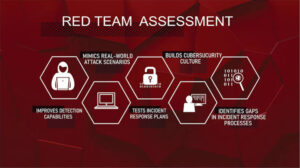
How does a red team assessment differ from penetration testing?
Another important difference lies in the techniques used throughout the engagement. Penetration testers generally rely on vulnerability discovery, exploitation, privilege escalation, and post-exploitation activities to demonstrate technical risks. Their work is focused on proving that vulnerabilities exist and assessing their severity. A red team assessment goes beyond technical exploitation by incorporating tactics commonly used by advanced threat actors. These may include phishing campaigns, social engineering, credential theft, physical intrusion attempts, malware simulation, persistence mechanisms, lateral movement, and covert communication methods. The objective is to replicate the behavior of determined attackers while remaining as undetected as possible throughout the exercise.
Detection and response are central elements that distinguish a red team assessment from traditional penetration testing. During most penetration tests, the organization’s security team is often aware that testing is taking place, even if they do not know the exact methods being used. The primary goal is vulnerability identification rather than measuring operational response. In contrast, simulated adversarial exercises are frequently conducted without informing the defensive team about the timing or attack techniques. This allows organizations to evaluate whether their monitoring systems, security analysts, and incident response procedures can identify suspicious activity quickly and respond effectively before attackers achieve their objectives.
The final deliverables produced by each engagement also differ considerably. Penetration testing reports primarily contain detailed technical findings, including exploited vulnerabilities, proof of concept, severity ratings, affected systems, and recommendations for remediation. These reports help technical teams prioritize security fixes and strengthen system configurations. A red team assessment generates a broader analysis that explains how attackers gained access, bypassed defenses, maintained persistence, moved throughout the environment, and achieved or failed to achieve predefined objectives. The report also evaluates detection capabilities, communication processes, incident response effectiveness, and overall organizational resilience against sophisticated attacks.
Organizations at different stages of cybersecurity maturity often benefit from different types of assessments. Businesses that are building their security programs may initially prioritize penetration testing because it helps identify common vulnerabilities that can be addressed quickly. Once an organization has implemented strong security controls and established monitoring capabilities, a red team assessment becomes increasingly valuable. It validates whether existing investments in cybersecurity technologies, employee training, and incident response planning perform effectively under realistic attack conditions. This progression allows organizations to continually improve their defenses while adapting to evolving cyber threats.
Both approaches contribute significantly to regulatory compliance and risk management, but they support these objectives in different ways. Penetration testing is frequently required by compliance standards because it demonstrates that organizations regularly assess their systems for known vulnerabilities. A red team assessment complements these requirements by providing executive leadership with practical evidence of how security controls function during realistic attack scenarios. The insights gained enable decision-makers to prioritize investments, improve security governance, strengthen operational procedures, and enhance overall cyber resilience across the organization.
Rather than viewing penetration testing and a red team assessment as competing services, organizations should consider them complementary components of a comprehensive cybersecurity strategy. Penetration testing identifies weaknesses that need immediate remediation, while broader adversarial simulations determine whether those weaknesses can be exploited to compromise critical assets despite existing security controls. Together, these assessments provide technical teams and business leaders with a complete understanding of their security posture, allowing them to reduce risks more effectively and prepare for increasingly sophisticated cyber threats. As cybercriminals continue to develop new attack techniques, combining proactive vulnerability identification with realistic adversarial testing helps organizations build stronger defenses, improve incident response capabilities, and maintain greater confidence in their ability to protect valuable information and critical business operations.